Argentina World Cup 2026 Preview: Scaloni's Title Defense
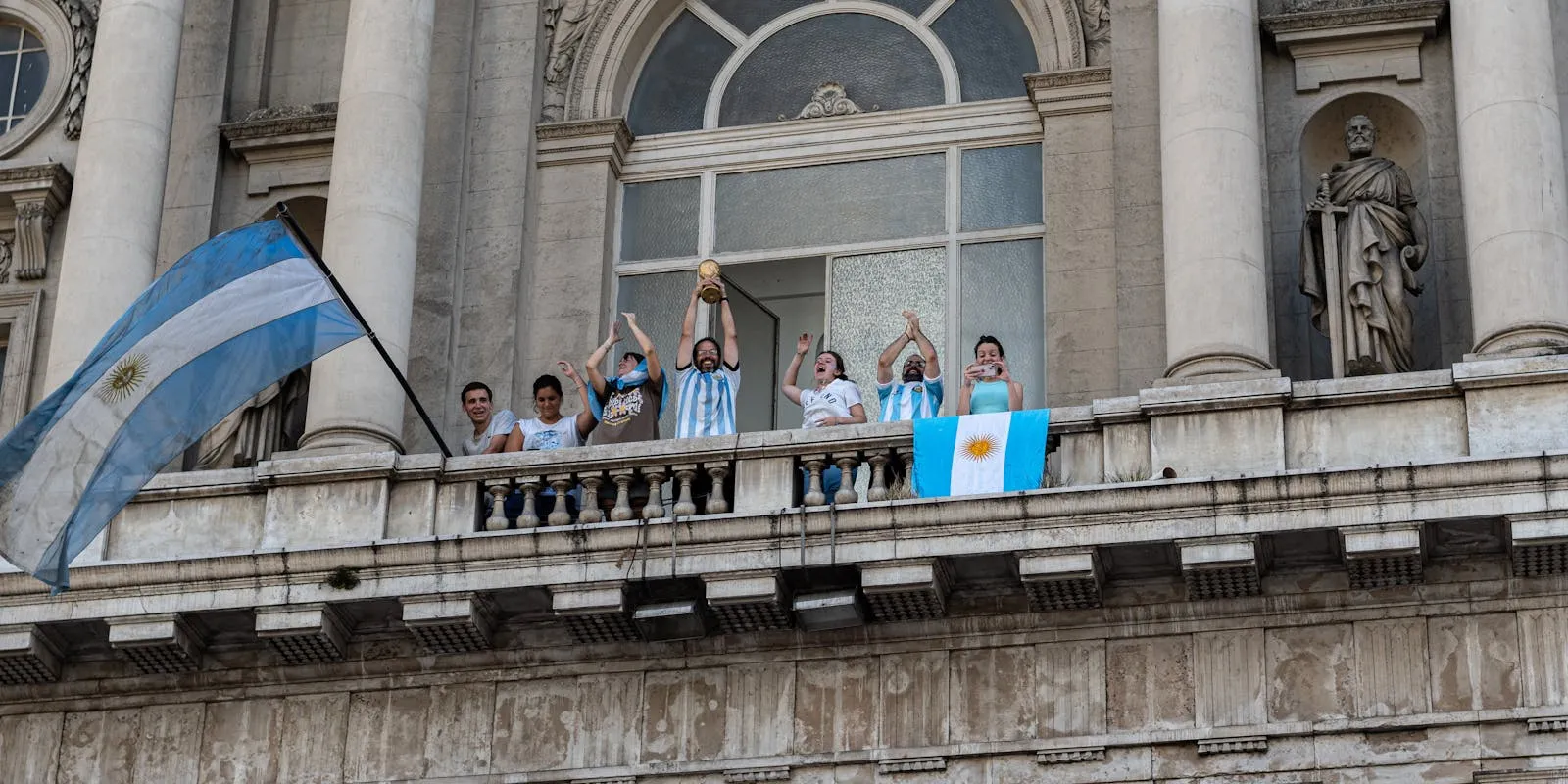
Argentina arrive at World Cup 2026 as defending champions — FIFA #3, reigning Copa América holders, and with the same coach and core that won in Qatar 2022.
Argentina's 4-3-3 Formation Explained
Argentina's shape is a 4-3-3 on paper and often a 4-4-2 out of possession. Rodrigo De Paul is the engine — the midfielder Messi repeatedly credited as his on-pitch lieutenant after the 2022 final. Alongside him, Enzo Fernández brings younger legs, long-range passing and the ability to carry the ball through opposition lines.
The third midfielder is typically Alexis Mac Allister in a slightly higher position, giving Argentina a left-sided presence that links to the front three and allows Messi to drift toward the centre.
The back four is Nahuel Molina on the right, Nicolás Otamendi and Cristian Romero at centre-back, and Nicolás Tagliafico on the left, with Facundo Medina the back-up after Marcos Acuña was left out of the final 26 on fitness grounds. In goal, Emiliano "Dibu" Martínez — the 2022 Golden Glove winner and penalty shootout specialist — remains Scaloni's first choice.
The attacking trident rotates between Lionel Messi, Lautaro Martínez and Julián Álvarez. Any two of the three can play together; which two depends on the opponent.
The Scaloni Mid-Block: Absorb, Then Strike
Scaloni does not ask Argentina to dominate the ball. The 2022 World Cup-winning side averaged less possession than four of the teams it beat in the knockouts. Argentina instead defend in a compact 4-4-2 shape, deny the central zone, and force opponents to play around a structure that closes quickly once the ball enters midfield.
When Argentina win the ball, everything accelerates. De Paul or Mac Allister find Messi or Álvarez in the pocket between the lines. The ball goes forward before the opponent resets. This is the sequence that produced Argentina's opening goal in the 2022 final — a Di María break that culminated in a Messi penalty — and the pattern repeats whenever opponents commit players forward.
The shape also lets Messi conserve energy. At 38, he cannot press for 90 minutes. The mid-block hides that by asking the rest of the team to do the running while Messi waits in a forward pocket.
Messi's Free Role: The Whole System Points Here
Lionel Messi turns 39 during the tournament. He has been Argentina's captain since 2011, won his first World Cup in 2022, and is widely expected to retire from international football after 2026. Scaloni's system exists to make the most of whatever miles Messi has left.
He operates as a right-sided No. 10 drifting inward — the same role he refined at Inter Miami. He does not press. He does not track back. What he does is take the first pass out of pressure and find the vertical ball through lines that opponents spend the entire match trying to block.
The full-back on his side (Molina) pushes on to give Argentina width. Álvarez or Lautaro pin the back line. The wingers — when Scaloni picks a winger — stay wide to create space for Messi to step inside. Stop Messi and you have to stop the exit from every Argentina transition; almost no team has solved that since 2022.
The Lautaro–Álvarez Rotation
Argentina's centre-forward battle is the rare squad choice with no wrong answer.
Lautaro Martínez — Inter Milan's captain — is Argentina's most prolific penalty-area finisher, with a sharp sense of when to peel off the shoulder of the last defender. Julián Álvarez — now at Atlético Madrid after leaving Manchester City — is a different profile: a No. 9 who drops into midfield, links play and runs in behind equally well.
Against low blocks, Argentina often want Álvarez's link play alongside Lautaro's finishing. Against higher lines, Lautaro's runs in behind become the first priority. Messi can also float between a right-sided attacker and a false-nine when Scaloni wants three midfielders and one pure striker.
Whichever pairing Scaloni picks, it is almost certainly the strongest attack depth Argentina have brought to a tournament since 2014.
The Defensive Spine: Romero, Otamendi and Dibu
Cristian Romero — Tottenham's captain and one of the most aggressive ball-winning centre-backs in Europe — is the linchpin of a back line that plays higher than the mid-block suggests. Nicolás Otamendi, at 38, is still Argentina's preferred partner for his communication and set-piece threat.
The risk is obvious: Otamendi's recovery pace. Against quick forwards — see Kylian Mbappé in the 2022 final — Argentina rely on Romero to step aggressively and on Dibu Martínez to sweep what gets past. It worked three years ago. The same question will be asked in 2026.
Emiliano Martínez in goal changes Argentina's calculus in knockout football. His penalty record is the best in the world, and his recovery saves have bailed out the back line in every major tournament since 2021.
Argentina's Path Through Group J
Argentina's group is one of the friendlier draws at the tournament, but each fixture carries its own tactical test.
- Jun 16 vs Algeria — Arrowhead Stadium, Kansas City. Algeria are the most talented of Argentina's three group opponents and will test whether the mid-block still compresses well enough to deny central passes. A late kickoff (01:00 UTC, 20:00 local) keeps Messi out of the worst summer heat.
- Jun 22 vs Austria — AT&T Stadium, Arlington. The most tactically serious match in the group. Austria, under Ralf Rangnick's pressing template, are exactly the profile Argentina's mid-block is designed to break: hungry to press, vulnerable to the ball going over them to Messi.
- Jun 27 vs Jordan — AT&T Stadium, Arlington. A low-block finisher. Jordan will defend deep; Argentina need Álvarez or Mac Allister to break structure, and Scaloni may rotate to save Messi's legs for the Round of 32.
Arlington's indoor AT&T Stadium (air-conditioned, no altitude) helps. Kansas City's outdoor heat does not. Argentina should enter the knockouts fresher than most of their rivals. For the full bracket path through the knockout rounds see our Argentina knockout path breakdown.
The Title-Defence Question: History Says No
No team has defended the men's World Cup since Brazil did it across 1958 and 1962. Italy failed in 1938→50, Brazil failed in 1962→70, West Germany in 1974→78, Argentina themselves in 1978→82 and 1986→90, Brazil again in 2002→06, Spain in 2010→14, Germany in 2014→18, and France in 2018→22. Sixty-four years of "next one will be different" — and none have been.
The case for Argentina is that Scaloni has now won three consecutive major tournaments with largely the same spine: 2021 Copa América, 2022 World Cup, 2024 Copa América. The template has survived Messi's transfer from PSG to Inter Miami, Di María's retirement from international football, and the natural aging of Otamendi. That is unusual continuity.
The case against is equally obvious. Messi is older. Otamendi is older. The minutes in their legs across three years of Champions League / MLS / Premier League / La Liga commitments are real. One bad draw for a centre-back, one tired sprint from Messi, and the defending-champion narrative ends before the Round of 16. The fixture list piles on too — UCL semi-final week alone exposes both Argentina and Brazil to fresh injury risk just before the squad-deadline window closes.
Final Thoughts
Argentina at 2026 are the rarest of tournament entries — the defending champions who still look like the most organised version of themselves. Scaloni has a structure, a spine and a captain who has already delivered the hardest trophy in international football. That combination does not come around often.
If the mid-block still compresses, if Messi has two or three moments of Messi-level brilliance in the knockouts, and if Romero and Otamendi hold up against top-tier wide pace, Argentina could do what no team has done in 64 years. The template is there. The question is whether the legs are too.
For the wider picture, see Ancelotti's rebuilt Brazil across the South American divide, Deschamps' France in a potential 2022 rematch, where the FIFA top five stack up heading into June, and the ten biggest questions before Mexico City kicks off.
Frequently Asked Questions
What formation will Argentina use at World Cup 2026?
A 4-3-3 that operates more like a 4-4-2 in defence. Lionel Scaloni uses a compact mid-block, a physical double pivot of Rodrigo De Paul and Enzo Fernández, and releases Lionel Messi in the pocket between the lines when Argentina win the ball.
Who are Argentina's key players at World Cup 2026?
Lionel Messi (38 during the tournament) is the creative axis, with Rodrigo De Paul and Enzo Fernández in midfield, Alexis Mac Allister as the third interior, Lautaro Martínez and Julián Álvarez rotating at centre-forward, Cristian Romero and Nicolás Otamendi at centre-back, and Emiliano 'Dibu' Martínez in goal.
What is Argentina's biggest tactical risk?
Age and minutes. The core of the 2022 title — Messi, Otamendi, Di María (if selected), Ángel Correa — is older, and the mid-block requires constant lateral running. If Argentina drop deeper than they want, they lose the transitions that made them champions.
Who is Argentina's coach at World Cup 2026?
Lionel Scaloni, the 2022 World Cup-winning head coach. He has added Copa América 2021 and Copa América 2024 titles to the same group, making Argentina three-for-three in major tournaments under his leadership.
Which group is Argentina in at the 2026 World Cup?
Group J with Algeria, Austria and Jordan. Argentina open against Algeria on Jun 16 at Arrowhead Stadium, face Austria on Jun 22 at AT&T Stadium, and finish with Jordan on Jun 27 at AT&T Stadium.
Is this Messi's last World Cup?
Almost certainly. Lionel Messi turns 39 during the tournament and has said 2026 is expected to be his final World Cup. Argentina's plan is to build around him one more time — and give him, and the country, a defence of the title won in Qatar 2022.
People Also Ask
Data sources
- FIFA — Group J fixtures and the Argentina opener at Arrowhead Stadium on June 16
- AFA — Argentine Football Association, official squad and Scaloni press conferences
- CONMEBOL — South American qualification records and head-to-head data
- FIFA Men's World Ranking — Argentina's current ranking and trajectory — Editorial review by the WTK Sports desk. Squad commentary reflects information available at publication; final squad lock is May 27 and any pre-tournament friendly injuries may shift first-choice availability.
Published: